Description
Want to complete your ICF AATC & gain your ACTC? Read on…
-
Do you have training & experience in team coaching?
-
Do you supervise team coaches, or plan to, & need the ACTC to keep doing so from January 2027?
-
Would you like to learn with the ICF Coaching Impact Award-winning training provider for 2023?
-
Do you want to learn from a faculty of ICF MCCs who hold the ACTC or equivalent & are ICF CSS & EMCC ESIA-accredited SUPERvisors?
-
Are you ready to partner with teams & boards to optimise their performance & impact?
-
Do you need to sharpen your value proposition, pricing & pitch as a team coach?
-
Do you want approaches that are simple, creative & effective, online & in person?
-
Are you curious about AI & CoachTech, return on expectations & measuring impact?
-
Do you need SUPERvision on your team coaching for ICF ACTC, or for EMCC or AC accreditation?
-
Would you value a safe space to unpack ethical dilemmas in your team coaching work?
Then this programme is for you.


Why now?
SUPERvisors of team coaches: the rules change in January 2027. From January 2027, SUPERvisors who support coaches working towards, or holding, the ACTC must themselves hold the ACTC or a team coaching credential from another recognised professional body (ICF, 2026a; ICF, 2026b). If you SUPERvise team coaches, or want to, this is your route.
ACTC holders are still rare. At the end of 2023 there were only 347 active ICF ACTC holders worldwide (Coaching.com, n.d.). Organisations increasingly want team coaches who can evidence their expertise.
Team coaching is growing. ICF notes significant growth in team coaching in recent years (ICF, n.d.). The ACTC validates your expertise in this specialised field.
Your SUPERvision will count. From 2027, SUPERvision hours for ACTC applicants must be with a qualified SUPERvisor (ICF, 2026). Ours are ICF CSS & EMCC ESIA-accredited, & hold the ACTC or equivalent.
Created & led by Dr Clare Beckett-McInroy
EdD MAEd BA (Hons) QTS MCC ACTC MP ESIA MCS CSS
-
Triple award-winning Relational Systemic Team Coach, with EMCC awards in Team Coaching
-
EMCC Coach of the Year
-
ICF Advisory Committee member for SUPERvision & Mentor Coaching; co-founder of ICF Bahrain & ICF Qatar
-
Author of Creative Reflective Practice
A global faculty of 17 ICF MCCs
-
Every faculty member is an ICF Master Certified Coach (MCC)
-
Everyone delivering on this programme holds the ICF ACTC or equivalent
-
All are ICF CSS & EMCC ESIA-accredited SUPERvisors
-
ICF & EMCC award-winning team coaches, working across sectors, globally
Awards & accreditation
-
ICF Advanced Accreditation in Team Coaching (AATC)
-
Association for Coaching (AC) Accredited Diploma in Coach Training
-
ICF Coaching Impact Award-winning training provider, 2023
-
ICF Prism Award, 2020, with Qatar Financial Centre for creating a coaching culture
-
3,000+ graduates; 45+ MCCs graduated from our Level 3 programme
What’s included
- 40 models, tools & techniques for team & board coaching
- A range of modalities: gestalt, results-focused, psychodynamic & more
- Creative approaches for online & in-person work with teams
- Pricing, pitching & promoting team coaching
- Create your signature offering
- All required SUPERvision for your ACTC
- Stories from our ICF & EMCC award-winning global faculty about their work as team coaches across sectors, globally
What we will explore: Understand. Do. Be.
What team coaches need to understand, what they need to be able to do, & how they develop the presence & judgement to do it well. Content is indicative.
Understand – lenses, theory & context
- ICF Team Coaching Competencies & ethics – coaching the team as one entity; confidentiality; multiple roles (ICF, 2020; ICF, 2025)
- Team or group? – real teams, working groups & pseudo teams (Katzenbach & Smith, 1993; Hackman, 2002)
- Team coaching vs facilitation, training, consulting & mentoring – clear boundaries & role transparency (ICF, 2020; Thornton, 2016)
- Relational-systemic lens – systems theory, field theory & systemic coaching (von Bertalanffy, 1968; Bateson, 1972; Lewin, 1951; Hawkins & Turner, 2020)
- Team effectiveness models – Six Conditions, Five Disciplines, PERILL & Five Dysfunctions (Hackman, 2002; Wageman et al., 2008; Hawkins, 2021; Clutterbuck, 2020; Lencioni, 2002)
- Team life cycle & maturity – (Tuckman & Jensen, 1977; Gersick, 1988; Wheelan, 2005)
- Group dynamics, power & the unconscious – (Bion, 1961; Schutz, 1958; Kantor, 2012; Oshry, 2007)
- Board coaching nuances – senior leadership teams & board effectiveness (Wageman et al., 2008; Garratt, 1987)
- Difference in teams – culture, neurodivergence & other nuances
- Team emotional intelligence – group EI norms (Druskat & Wolff, 2001)
- Complexity – complex responsive processes, Cynefin & polarities (Stacey, 2003; Snowden & Boone, 2007; Johnson, 1992)
- The changing landscape – AI & other technologies in & around teams
- Psychology & neuroscience of teams – SCARF & polyvagal theory (Rock, 2008; Porges, 2011)
- Hope & resilience – (Snyder, 2002; Masten, 2001)
- Trauma-aware team coaching – (SAMHSA, 2014; Porges, 2011)
- Existential, somatic, gestalt & psychodynamic perspectives – (Perls, Hefferline & Goodman, 1951; Bion, 1961)
Do – practice & the business of team coaching
- Multi-party contracting – sponsor, leader, members & co-coaches; the three-cornered contract (English, 1975; ICF, 2020)
- Stakeholder mapping & the wider system – (Hawkins, 2021)
- Diagnosing needs – discovery interviews, observation & diagnostics incl. TAP360 (Wageman, Hackman & Lehman, 2005)
- Team coaching roadmaps – from scoping to stepping away (Clutterbuck, 2020)
- Psychological safety, trust & norms – (Edmondson, 1999; 2019; Wageman et al., 2008)
- Conflict & difficult conversations – (Thomas & Kilmann, 1974; Gottman, 1994)
- Purpose, identity & shared narrative – (Hackman, 2002)
- Working with values – values in action within the team & its system
- Developing the team leader – distributed leadership & timing interventions (Hackman, Wageman & Fisher, 2009)
- Team learning & innovation – (Senge, 1990; Argyris & Schön, 1978; Edmondson, 2012; Revans, 1980)
- Creative approaches & humour – online & in person
- Systemic constellations – (Hellinger, Weber & Beaumont, 1998; Whittington, 2016)
- Co-team coaching – working as a coaching pair (ICF, 2020)
- Virtual, hybrid & agile teams – (Edmondson, 2012)
- Return on expectations, evaluation & endings – (Kirkpatrick, 1994; Phillips, 2003)
- Pricing, pitching & promoting – create your signature offering
- Case studies – across sectors, globally
Be – presence & judgement
- When team coaches are triggered – the drama triangle (Karpman, 1968)
- Being part of the system you coach – (Lewin, 1951)
- Shadow work – what the team, & the coach, cannot yet see
- Self-care for team coaches – sustaining yourself in complex systems
- Use of self & presence – your impact on the system
- SUPERvision for team coaches – all required SUPERvision included (Hawkins & Shohet, 1989)
You will be able to:
- Identify signs of ineffective teams & ways to intervene as a team coach
- Navigate the tensions between individual & collective team needs
- Contract with sponsors, leaders, members & co-coaches
- Build psychological safety, drawing on the neuroscience of emotional resonance
- Coach boards & senior leadership teams with confidence
- Engage in embodied & creative practices
- Use the ICF Team Coaching Competencies in your practice
- Price, pitch & promote your signature team coaching offer
Frequently asked questions:
I already have team coach training. Do I need to repeat it?
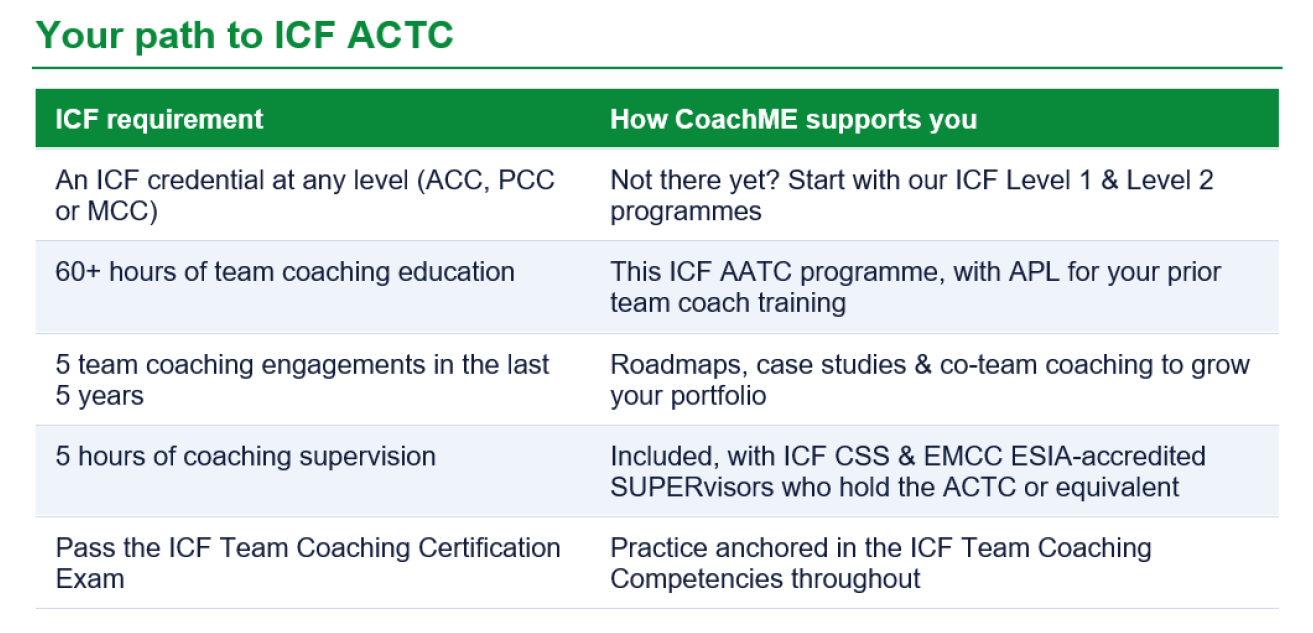
No. We accept accredited prior learning (APL). Send us details of your training & we will confirm what you need to complete.
Is SUPERvision really included?
Yes. All the SUPERvision you need for your ACTC application is included, with ICF CSS & EMCC ESIA-accredited SUPERvisors who hold the ACTC or equivalent.
I am a SUPERvisor. Why do I need the ACTC?
From January 2027, SUPERvisors supporting coaches working towards, or holding, the ACTC must hold the ACTC or a team coaching credential from another recognised professional body (ICF, 2026a; ICF, 2026b).
Can I join just for CCEs?
Yes. Join the live sessions for 30 ICF CCE units without completing the AATC, for USD 2,195.
Can you run this in-house?
Yes, in person in your country or organisation, on request, for 8+ people.
Contact [email protected] to book your place or for more information.